
Introduction
In today's digital landscape, users expect personalized, timely, and relevant interactions at every stage of their journey. But managing this manually? Nearly impossible. That's why businesses are turning to marketing automation SaaS.
If you've ever struggled with:
- • Low user engagement
- • Drop-offs in onboarding
- • Poor conversion rates
The problem isn't your product; it's the lack of automated user journeys. In this guide, we'll show you how to automate user journeys using marketing automation SaaS and how it can transform your growth strategy.
What is Marketing Automation SaaS?
Marketing automation SaaS refers to cloud-based platforms that help businesses automate marketing tasks, workflows, and user interactions across different stages of the customer journey. These platforms enable automated campaigns, user segmentation, behavior-based messaging, and lifecycle marketing.
In simple terms: it helps you deliver the right message to the right user at the right time, automatically.
Why Automating User Journeys is Critical
User journeys are no longer linear. Users interact with products across multiple touchpoints, emails, apps, websites, and more.
Without automation, engagement becomes inconsistent, opportunities are missed, and conversions drop.
With automation:
- • Consistent communication
- • Personalized user experience
- • Higher engagement and retention
- • Scalable marketing efforts
Automation ensures no user is ignored.
What is a User Journey in Marketing?
A user journey is the complete path a user takes, from first interaction to conversion and beyond.
Key stages include:
- • Awareness
- • Consideration
- • Activation
- • Engagement
- • Retention
- • Conversion
Each stage requires different messaging and actions, which is where automation plays a key role.
How Marketing Automation SaaS Works
Marketing automation platforms work by combining:
User Data
Track behavior like clicks, visits, and actions.
Segmentation
Group users based on behavior, demographics, or lifecycle stage.
Triggers
Set actions based on events (e.g., signup, inactivity).
Workflows
Automated sequences of messages or actions.
Channels
Email, push notifications, SMS, in-app messages.
Together, these create a fully automated user engagement system.
Step-by-Step: How to Automate User Journeys
Step 1: Map Your User Journey
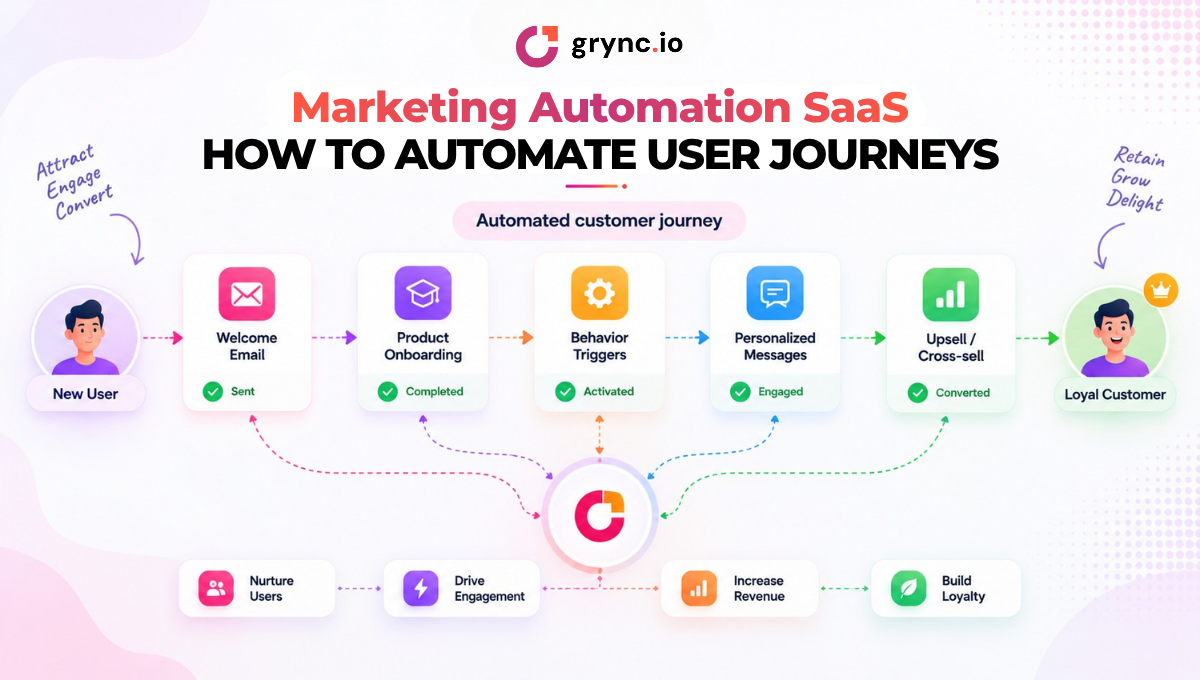
Start by defining your user journey stages: new user onboarding, active user engagement, inactive user re-engagement, and conversion journey. Identify key touchpoints where users interact with your product.
Step 2: Define User Segments
Segment users based on behavior (active/inactive), actions (signed up, purchased), and demographics. Segmentation ensures personalized communication.
Step 3: Set Up Event Tracking
Track important events like sign-ups, feature usage, drop-offs, and purchases. This is the foundation of automated user engagement.
Step 4: Create Automation Workflows
Design workflows such as welcome email sequences, onboarding guidance, feature adoption nudges, and abandoned action reminders. These workflows run automatically based on user actions.
Step 5: Use Multi-Channel Campaigns
Engage users across channels: email campaigns, push notifications, and in-app messages. Consistent communication improves engagement.
Step 6: Optimize with Data
Analyze performance: open rates, click rates, and conversions. Continuously improve workflows for better results.
Key Use Cases of Marketing Automation SaaS
Onboarding Automation
Guide new users step-by-step to activate them quickly.
User Engagement
Send personalized messages based on user behavior.
Re-Engagement Campaigns
Win back inactive users with targeted messaging.
Conversion Optimization
Trigger offers or reminders to convert users.
Lifecycle Marketing
Automate communication across the entire user lifecycle.
Benefits of Marketing Automation SaaS
Saves Time & Effort
Automates repetitive tasks.
Improves Personalization
Delivers relevant messages to each user.
Increases Conversions
Right message at the right time.
Scales Easily
Handle thousands of users effortlessly.
Data-Driven Decisions
Optimize campaigns based on real insights.
Features to Look for in a Marketing Automation Platform
When choosing a marketing automation SaaS platform, look for:
- • Workflow builder
- • Event tracking
- • User segmentation
- • Multi-channel support
- • Real-time analytics
- • AI-driven insights
The right platform should make automation simple and effective.
Challenges Without Automation
Without automation, businesses face:
- • Manual workload
- • Missed engagement opportunities
- • Inconsistent communication
- • Low retention rates
Automation solves these issues at scale.
Future of Marketing Automation
The future lies in:
- • AI-driven personalization
- • Predictive user behavior
- • Automated decision-making
- • Real-time engagement
Marketing automation is evolving from a tool to a growth engine.
Why Your Business Needs Marketing Automation SaaS Now
If you want to improve user engagement, increase conversions, and scale marketing efforts, then investing in a marketing automation SaaS platform is no longer optional, it's essential.
Ready to automate your user journeys and drive real growth? Book a demo today.
FAQs
It is a cloud-based platform that automates marketing tasks, workflows, and user engagement.
It uses data, triggers, and workflows to send personalized messages automatically.
These are pre-defined workflows that guide users through different stages based on their actions.
Yes, it helps businesses of all sizes scale their marketing efforts efficiently.
Lifecycle marketing focuses on engaging users at every stage, from awareness to retention.