Introduction
In today's SaaS world, building a product is not enough; ensuring users actually adopt and use it is the real challenge. Many companies invest heavily in product development but struggle with onboarding, feature adoption, and retention.
This is where a digital adoption platform (DAP) becomes essential. A DAP helps users understand your product faster through interactive walkthroughs, in-app guidance, feature adoption tools, and product onboarding flows.
Simply put, it ensures users don't just sign up; they stay, engage, and convert.
What is a Digital Adoption Platform?
A digital adoption platform (DAP) is like a guide that sits atop your software and helps users understand how to use it. In simple words, it works like a helper inside the app that:
- • Shows users step-by-step what to do
- • Makes it easy to move around the software
- • Clears confusion by giving tips and instructions
- • Helps users work faster and better
Instead of asking someone for help again and again, the software itself teaches the user. So basically, a DAP makes your software easy to understand, easy to use, and less dependent on human support.
Why SaaS Companies Need DAPs
Without a DAP:
- • Users drop off after signing up
- • Features go unused
- • Support tickets increase
- • Revenue potential is lost
With a DAP:
- • Faster onboarding
- • Higher feature adoption
- • Better user experience
- • Increased retention
Best Digital Adoption Platforms in 2026
1. WalkMe — Best for large enterprises
Step-by-step in-app guidance, strong enterprise integrations, and easy walkthrough creation. Known for helping users navigate complex systems easily.
2. Whatfix — Best for employee training & onboarding
Interactive walkthroughs, tooltips & pop-ups, and strong analytics. Helps improve productivity and reduce training time.
3. Pendo — Best for product-led growth
User behavior analytics, in-app guides, and feedback collection. Great for understanding what users use (and ignore).
4. Userlane — Best for no-code onboarding
Real-time guidance, no coding required, and easy deployment. Ideal for companies wanting a quick setup.
5. Apty — Best for process compliance & analytics
Tracks user behavior, improves workflows, and ensures process adherence. Strong for enterprise-level operations.
6. Stonly — Best for customer support + onboarding
Interactive guides, knowledge base integration, and decision trees. Combines onboarding with support tools.
7. grync.io — Best for action-driven growth & revenue optimization
Unlike traditional DAPs that focus only on guidance, grync.io goes a step further. Key features include unified data from product, CRM, and support tools; AI-driven insights and automated actions; real-time user behavior tracking; and revenue-focused workflows. It doesn't just show insights, it helps teams take action instantly.
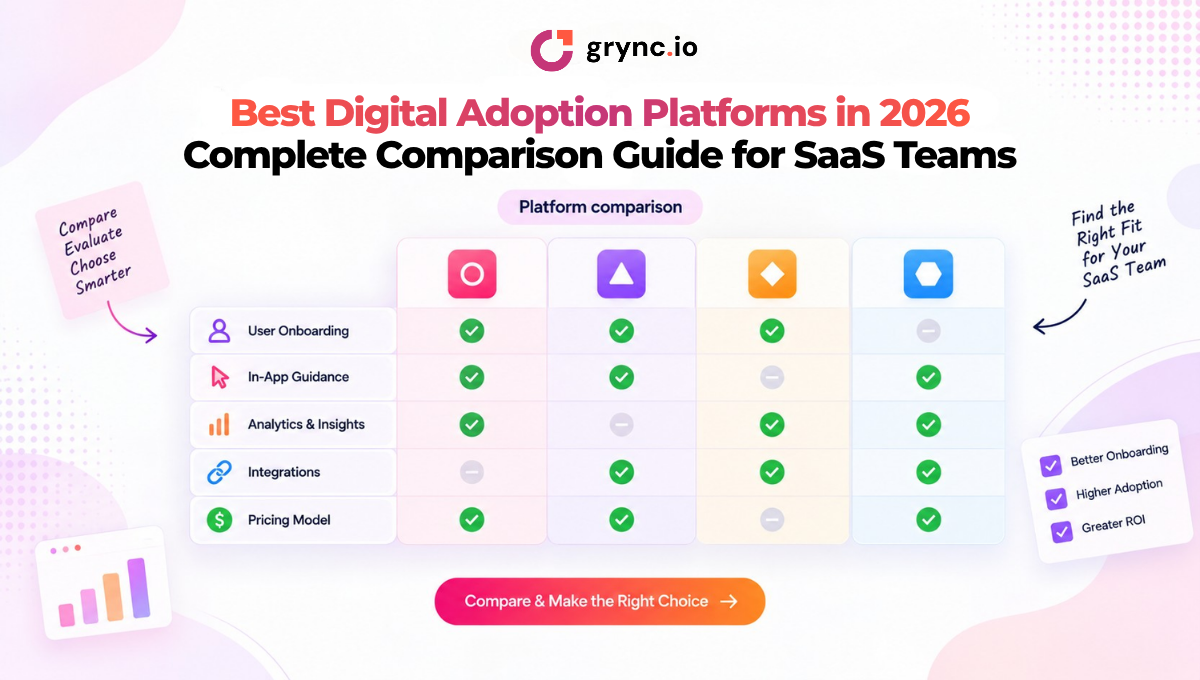
Comparison Table: Best Digital Adoption Platforms
| Platform | Best For | Key Strength | Limitation |
|---|---|---|---|
| WalkMe | Enterprises | Advanced guidance | Complex setup |
| Whatfix | Training | Strong onboarding tools | Expensive |
| Pendo | Product teams | Analytics + feedback | Limited automation |
| Userlane | No-code users | Easy setup | Less advanced analytics |
| Apty | Compliance | Process optimization | Enterprise-focused |
| Stonly | Support teams | Knowledge + onboarding | Limited DAP features |
| grync.io | Growth teams | Action + revenue focus | Newer platform |
How to Choose the Best Digital Adoption Platform
Choose WalkMe / Whatfix if:
You need enterprise-level onboarding.
Choose Pendo if:
You want strong product analytics.
Choose Userlane / Stonly if:
You want an easy setup.
Choose grync.io if:
You want growth + action + revenue optimization in one platform.
Why grync.io is a Game-Changer
Most DAPs show data. But grync.io turns data into action.
Example: a user signs up but doesn't convert, grync.io automatically triggers actions to improve conversion.
This makes it more than a DAP; it becomes a growth engine.
Final Verdict
Digital adoption platforms are no longer optional; they are essential for SaaS success.
If your goal is:
- • Better onboarding → Whatfix / WalkMe
- • Better analytics → Pendo
- • Faster setup → Userlane
"But if your goal is real growth, conversions, and revenue impact, grync.io is the best choice."
Struggling with low adoption and missed revenue opportunities?
See how grync.io.io helps you convert user actions into measurable growth.
FAQs
A digital adoption platform is software that sits on top of your product and guides users through it, in-app, with walkthroughs, tooltips, and step-by-step prompts, so they learn how to use the product without needing to read documentation or contact support.
Not every company needs one from day one, but any SaaS product with more than a handful of features usually benefits. If users are dropping off during onboarding or ignoring features that could make them stickier, a DAP directly addresses that gap.
A product analytics tool tells you what users are doing, and where they're getting stuck. A DAP acts on that information by guiding the user in the moment. The two are complementary: analytics finds the problem, a DAP (or a platform like grync.io that combines both) helps solve it.
This varies by platform and complexity. No-code tools like Userlane can often be set up in days, while enterprise-grade platforms like WalkMe may take weeks to fully configure across a large, complex product. Evaluate based on how much customization your onboarding flows actually need.
Smaller teams generally do well with simpler, faster-to-deploy tools like Userlane or Stonly. Larger enterprises with complex compliance or training needs tend to lean toward WalkMe or Apty. If the goal is connecting adoption directly to revenue outcomes rather than just guidance, that's where a platform like grync.io fits in.