
Introduction
In the world of SaaS, growth is not just about acquiring new customers; it's about retaining them. Yet, churn in SaaS remains one of the biggest challenges companies face today. Every month, businesses lose customers, often without understanding why.
While many teams track churn metrics, they struggle to predict churn early enough to take action. Traditional metrics only show what has already happened; they don't provide insights into what's about to happen next.
This is where modern solutions like churn prediction software come into play. Instead of reacting after customers leave, SaaS companies are now focusing on predicting churn before it happens.
So the real question is: How do SaaS companies know which customers are about to churn?
The Measurement Trap: Why Tracking Churn Is Not the Same as Preventing It
Most SaaS teams measure churn. Very few prevent it. There is a critical difference between those two things, and understanding it is the first step to building a retention strategy that actually works.
Churn metrics tell you that customers left. They do not tell you why, when the signal appeared, or what could have been done. By the time churn shows up in a dashboard, the window for intervention has already closed.
The infrastructure gap is real. Most SaaS companies today have three separate problems working against them:
- • They measure churn with one tool
- • They track user behavior with another tool
- • They take action through a third tool manually, after a delay
None of these tools talk to each other in real time. The result is a broken loop where signals decay before they become actions, and actions come too late to change outcomes.
Predicting churn requires closing that loop, connecting behavioral signals to risk scores to automated responses, all within a single platform that acts without waiting for a human to connect the dots.
What Is Customer Churn in SaaS
Customer churn refers to the situation when users stop using a product or cancel their subscription. In simple terms, it is the loss of customers over time.
In SaaS businesses, churn has a direct impact on revenue and growth. Even if a company acquires new users, losing existing ones slows down progress.
For example, if a SaaS platform loses 10% of its customers every month, it must constantly acquire new users just to maintain growth.
While churn is natural, controlling it is critical. This is why understanding churn meaning in business and tracking customer churn in SaaS is essential for long-term success.
Understanding Churn Metrics SaaS Teams Track
To manage churn effectively, SaaS companies rely on different churn metrics. These help measure how many customers are leaving over time. Some of the most important metrics include:
- • Customer Churn Rate – Percentage of customers lost
- • Revenue Churn – Loss in recurring revenue
- • Monthly Churn Rate – Monthly customer loss
Churn Rate Formula
Churn Rate = (Customers Lost / Total Customers at Start) × 100
These metrics are essential for calculating churn and understanding business performance. However, they have one limitation: they only explain past churn, not future churn.
Average SaaS Churn Rate Benchmarks
Understanding the average SaaS churn rate helps businesses evaluate performance.
- • Early-stage SaaS companies often have higher churn rates
- • Mature SaaS companies typically maintain lower churn rates
Industry benchmarks vary, but a high churn rate usually signals:
- • Poor onboarding
- • Weak product experience
- • Lack of customer engagement
Tracking SaaS churn benchmarks helps businesses identify gaps and improve retention strategies.
Why Reducing Customer Churn Is Critical
Reducing churn is one of the most powerful growth strategies in SaaS. Acquiring a new customer is far more expensive than retaining an existing one. Even a small improvement in retention can significantly increase revenue.
Benefits of reducing churn:
- • Lower customer acquisition cost
- • Higher lifetime value (LTV)
- • More predictable revenue
- • Increased expansion opportunities
This is why companies actively invest in reducing customer churn and building strong retention strategies.
How SaaS Companies Predict Customer Churn
Behavioral Signals of Churn
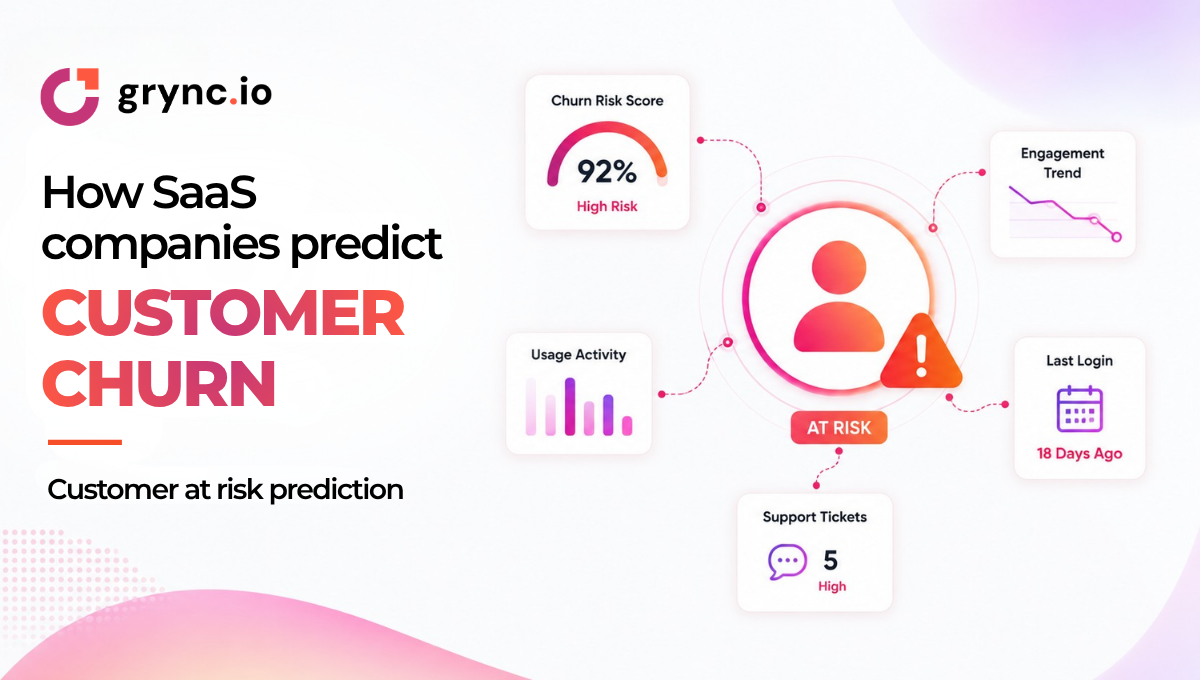
One of the most effective ways of predicting churn is by analyzing user behavior. Common churn signals include:
- • Drop in product usage
- • Decrease in login frequency
- • Low engagement levels
- • Increased support complaints
These signals indicate that a customer may leave soon.
Product Usage Patterns
Another important factor is how users interact with the product. Patterns that indicate churn risk:
- • Incomplete onboarding
- • Low feature adoption
- • Inactive users
When users fail to see value early, they are more likely to churn.
Customer Health Scores
Many SaaS companies use customer health scores to track engagement. This score combines multiple data points, such as:
- • Usage activity
- • Feature adoption
- • Engagement level
A low score signals a high churn risk, allowing teams to act early.
Predictive Analytics Models
Modern SaaS companies use predictive analytics SaaS tools to analyze user behavior, product engagement, and historical patterns. These models identify users who are most likely to churn, enabling proactive action.
How Churn Prediction Feeds Your Sales and Expansion Pipeline
Churn prediction is commonly understood as a retention tool. What is less commonly understood is that the same behavioral analytics driving churn prevention are also one of the most powerful inputs your sales team has ever had.
Here is why: the behavioral data that tells you a customer is about to churn also tells you — with equal precision, when a customer is ready to expand, upgrade, or become a reference account. These two signals come from the same source. The difference is in the interpretation.
Analytics as a Sales Signal, Not Just a Risk Signal
When product analytics shows that an account has crossed a usage threshold, activated a premium feature, or expanded to additional team members that is a buying signal. It is a sign that the customer has found value, is growing into the product, and is open to a conversation about expansion.
Most sales teams today receive this information late, if at all, buried in a CRM note or a weekly CS report. AI-powered analytics surfaces it in real time and routes it to the right person or triggers an automated expansion campaign automatically.
That disconnect is not just an operational inconvenience, it is a documented revenue problem. According to a Gartner survey, 84% of sales leaders report that their analytics tools do not meaningfully impact sales performance. The data exists. The dashboards are built. But without a direct connection from behavioral signal to sales action, the insights never reach the people who could act on them — and expansion revenue is left on the table.
| Behavioral Signal | Traditional Sales Interpretation | AI-Powered Sales Action |
|---|---|---|
| User invites 5+ teammates | Noticed in monthly review | Instant expansion prompt triggered |
| Account hits 80% of usage limit | Flagged at renewal | Upsell conversation initiated by AI now |
| 3 power users activate advanced feature | No signal to sales team | Account scored as expansion-ready, CS alerted |
| Support ticket resolved positively | Logged in CRM | NPS prompt + upgrade offer sent automatically |
This is how product analytics becomes a revenue function, not just a product function. It does not just protect existing revenue by preventing churn, it actively identifies and accelerates new revenue within the existing customer base.
"The best time to sell more to a customer is when the product data shows they are already getting value. AI analytics tells you exactly when that moment is."
Role of Churn Prediction Software
In today's competitive SaaS landscape, understanding customer behavior is essential for success. Churn prediction software has emerged as a vital tool for businesses looking to enhance their customer retention strategies. By analyzing various data points and behavioral patterns, these tools empower companies to identify potential churn risks early on, leading to more effective retention efforts.
Here's how churn prediction software can make a significant difference. It helps companies:
- • Collect product usage data
- • Track churn signals
- • Analyze behavioral patterns
- • Predict churn risk
Key benefits:
- • Early churn alerts
- • Better retention strategies
- • Improved customer experience
With the right churn analytics tools, businesses can move from reactive to proactive retention.
How AI Improves Churn Prediction
AI has transformed the way SaaS companies approach churn. Using machine learning, companies can detect hidden patterns, predict churn in real time, and improve prediction accuracy.
Detect Hidden Patterns
This involves identifying underlying trends and correlations in data that may not be immediately visible. Techniques like clustering, association rule mining, and anomaly detection can be used to discover these patterns — for instance, revealing groupings of customers with similar traits or preferences. Understanding customer segments, detecting fraud, and optimizing marketing strategies are some areas where hidden patterns are valuable.
Predict Churn in Real-Time
This refers to the capability to forecast customer attrition as it occurs, allowing businesses to take immediate action to retain customers. Real-time data analytics and machine learning models assess customer behavior and engagement, using inputs like purchase history, customer service interactions, and social media activity to enhance prediction accuracy. If a sudden drop in engagement is detected, the system can trigger a targeted email campaign to re-engage those customers.
Improve Prediction Accuracy
Enhancing the precision of predictive models ensures they yield more reliable and actionable insights. This can involve using more comprehensive datasets, refining algorithms, or employing ensemble methods that combine multiple models, along with continuous model training and validation against new data. High prediction accuracy ensures better decision-making, resource allocation, and customer satisfaction — companies can focus their retention strategies more effectively, maximizing return on investment in customer relationship management.
AI-powered churn analytics enables faster and smarter decision-making.
How SaaS Teams Use Churn Predictions
In the competitive landscape of Software as a Service (SaaS), understanding customer behavior is essential for sustained growth. One of the critical insights that teams can leverage is churn prediction, which allows organizations to identify users who may be at risk of disengaging. By anticipating these challenges, SaaS teams can implement proactive strategies that not only safeguard customer retention but also enhance the overall user experience.
So, when churn is predicted, teams can take action:
- • Customer success teams reach out to at-risk users
- • Product teams improve features
- • Marketing teams run targeted campaigns
This ensures customers stay engaged and continue using the product.
Introducing grync.io for Churn Prediction
Are you struggling to keep your SaaS customers engaged and prevent churn? Meet grync.io, the game-changer in churn prediction. Unlike basic analytics tools, grync.io seamlessly integrates product analytics, behavioral signals, and predictive insights with growth automation. This powerful combination empowers your team to spot churn signals early, predict potential customer loss with accuracy, and take proactive steps to retain users.
grync.io helps SaaS companies go beyond basic analytics by combining:
- • Product analytics
- • Behavioral signals
- • Predictive insights
- • Growth automation
With grync.io, teams can:
- • Identify churn signals early
- • Predict customer churn accurately
- • Take proactive actions to retain users
It's not just analytics, it's predictive intelligence for SaaS growth. If you want to predict churn before customers leave, it's time to upgrade your strategy.
If you want to predict churn before customers leave, it’s time to upgrade your strategy. See how grync.io helps SaaS teams detect churn signals early and take action faster.
FAQs
Customer churn is when users stop using a product or cancel their subscription.
It is the percentage of customers lost over a specific period.
They use behavioral data, product usage patterns, and predictive analytics models.
It is a tool that analyzes data and predicts which customers are likely to leave.
It helps companies take early action and improve retention strategies.