
Introduction: The Cost of Customer Churn in SaaS
Customer churn is one of the biggest growth barriers for any SaaS business. It refers to the percentage of customers who stop using your product, cancel subscriptions, or fail to renew over a given period. Even a small increase in churn can create a major revenue gap, especially in subscription-based businesses where recurring income drives long-term growth. That is why many companies now invest in reducing customer churn software to protect revenue and improve retention.
The problem is that traditional retention efforts often come too late. By the time a customer success manager notices low activity or a cancellation request, the account is already at risk. Static reports, delayed feedback, and manual follow-ups are not enough in a fast-moving SaaS environment. This is where churn prediction, customer churn analytics, and AI churn prevention are changing the game.
Instead of reacting after the damage is done, AI helps SaaS companies detect churn risk early, understand hidden behaviour patterns, and trigger timely action. As SaaS churn rate rises, businesses lose not only customers but also future upsell opportunities and expansion revenue. Investing in software that reduces customer churn is no longer just a retention tactic. It is a strategic growth decision.
What Is Customer Churn and Why Does It Happen?
At its core, churn means losing customers. In SaaS, churn usually falls into two categories: voluntary churn and involuntary churn. Voluntary churn happens when a customer actively chooses to cancel because they no longer see value, find the pricing too high, or switch to a competitor. Involuntary churn happens when a subscription ends because of failed payments, expired cards, or billing issues.
Most churn does not happen suddenly. It builds over time through missed signals that strong customer churn analytics can surface early. Common churn drivers include poor onboarding, low product adoption, lack of engagement, pricing mismatch, and poor customer experience. When users do not reach value quickly, fail to adopt core features, or feel unsupported, they slowly disengage.
Many SaaS teams also overlook important churn risk indicators such as fewer logins, reduced feature usage, longer inactive periods, support frustration, or declining engagement across teams. These are the early warning signs that often show up before cancellation. Monitoring SaaS retention metrics helps teams understand whether customers are healthy, at risk, or ready for expansion.
This is where churn prediction becomes powerful. Instead of waiting for churn to show up in monthly reports, predictive systems identify risk in advance. That turns churn management from a reactive cleanup exercise into proactive intelligence.
Why Traditional Retention Strategies Don’t Work
Most SaaS retention strategies are still reactive. Teams wait for support complaints, renewal hesitation, or a drop in account activity before stepping in. The problem is simple: by the time humans notice the issue, the customer may already be halfway out the door. That makes old-school retention processes slow, inconsistent, and hard to scale.
Manual customer success outreach has real limits. Teams cannot personally monitor every account, interpret every behavior pattern, and respond at the perfect moment. As customer volumes grow, these gaps widen. Even the best team will struggle to detect churn risk across hundreds or thousands of accounts without help from predictive retention software.
Static dashboards do not solve this either. They show what already happened, not what is about to happen. A report might show lower usage or fewer sessions, but it often lacks real-time interpretation and next-step recommendations. Without automation, those insights sit unused. There is no action layer to trigger emails, in-app guidance, or customer success intervention automatically.
This is why AI churn prevention is proving more effective. It is smarter because it spots subtle behaviour changes early. It is faster because it works in real time. And it is scalable because it can monitor every account continuously. For SaaS companies looking for automated churn prevention SaaS solutions, AI offers a stronger, more modern path to retention.
Why Analytics Alone Cannot Stop Churn
Many SaaS companies invest in analytics dashboards and believe that visibility equals retention. It does not. Knowing that a customer's usage has dropped by 40% is valuable — but only if something happens with that knowledge.
Analytics tells you what is happening. It does not fix it.
The gap between insight and action is where churn actually happens. A dashboard that shows risk without triggering a response is just an early warning system with no alarm.
The typical analytics-only workflow looks like this: data is collected, a report is generated, a team member reviews it days later, a decision is made, and by the time outreach happens, the customer has already decided to leave. Every step in that chain is a delay. Delays cost revenue.
What modern SaaS teams need is a system that closes the loop automatically, where behavioral signals detected by analytics instantly trigger the right retention action, without manual intervention. That is the difference between an analytics tool and an AI-powered churn prevention platform.
Analytics without action is observation. Analytics with automated action is retention.
How AI Churn Prediction Works
AI works best when connected to a unified customer data platform SaaS environment that brings together product data analytics, billing, support, and engagement signals. This allows real-time user behavior analytics, user behavior automation SaaS, and product analytics for retention to function as one system rather than separate tools.
Churn prediction works by combining behavioral data, usage patterns, and automated intelligence to estimate which customers are likely to leave. Instead of relying on assumptions, SaaS companies can use AI to track what users do, how often they engage, and where signs of disengagement begin.
The process starts with data collection. AI systems pull signals from feature usage, engagement frequency, session behavior, support tickets, account activity, onboarding milestones, and billing interactions. These inputs create a living picture of customer health. If usage drops, sessions become shorter, support issues increase, or adoption stalls, the system can catch it early through customer churn analytics.
Next comes behavioral pattern analysis. This is where AI churn prevention becomes especially valuable. The model compares current behavior with past churn outcomes and identifies risky patterns. It can detect things like a sudden decline in core feature use, a drop in team-wide adoption, or repeated support friction. This kind of AI customer behaviour modelling helps reveal what humans often miss.
Then the platform assigns a risk score. Many teams use customer health score software to classify accounts as healthy, at risk, or high-risk. Predictive churn alerts help revenue, product, and customer success teams prioritize action before cancellations happen.
The final step is an automated response. Once a customer crosses a risk threshold, the system can launch in-app prompts, personalized retention emails, discount triggers, onboarding help, or CS outreach automation. That is where the reduce customer churn software moves from insight to action.
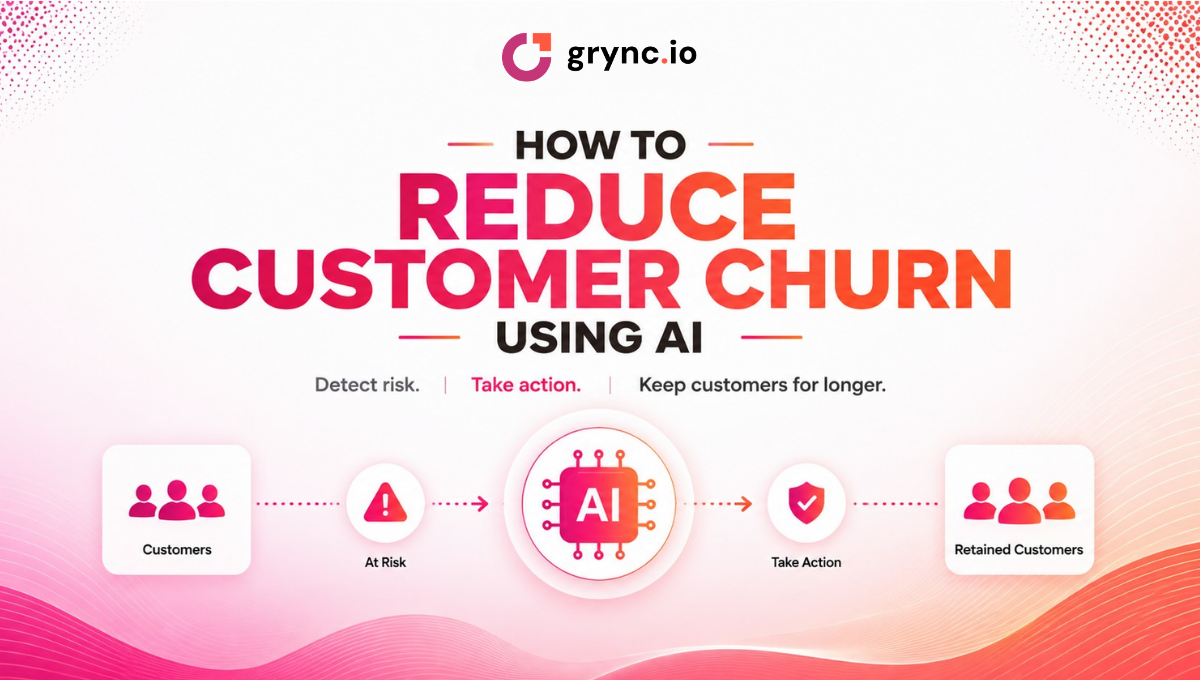
Data → AI Model → Risk Score → Automated Action → Retention
How Analytics Drives the Full Growth Chain
Analytics does not just prevent churn. When used actively, it drives the entire customer growth lifecycle, from first login to long-term expansion. Here is how each stage connects:
Stage 1: Engagement
Analytics identifies which users are engaging with which features and which are going dark. This allows teams to send targeted nudges — feature tips, onboarding prompts, or check-in messages — at exactly the right moment, before disengagement sets in.
Stage 2: Activation
Activation analytics reveals the exact behaviours that define a 'successful' user — the actions correlated with long-term retention. AI can then automatically guide new users toward those activation milestones, improving time-to-value dramatically.
Stage 3: Retention
Once users are activated, retention analytics monitors ongoing health. Drops in usage frequency, feature adoption gaps, or support friction all surface early, enabling automated retention workflows before the customer reaches cancellation.
Stage 4: Expansion
The same behavioral signals that predict churn can also identify expansion readiness. Accounts consistently hitting usage limits, activating advanced features, or growing their team footprint are candidates for upsell — and AI can trigger those conversations automatically.
The chain: Analytics → Engagement → Activation → Retention → Expansion. Each stage feeds the next. Miss one, and the revenue leak begins.
Key AI Strategies to Reduce Customer Churn
Predictive Churn Modelling
One of the most effective ways to reduce churn is with churn prediction software that identifies risk before a customer cancels. Instead of treating all accounts the same, predictive models analyze product usage, engagement trends, support history, billing events, and feature adoption patterns to forecast future churn.
This helps SaaS teams identify high-risk segments early. For example, a group of users with low adoption and poor onboarding completion may show a higher chance of leaving than power users with steady weekly activity. With strong customer churn analytics, teams can prioritize accounts that need immediate intervention and avoid wasting effort on low-risk customers.
Predictive modelling also improves timing. Rather than waiting for renewal season or cancellation signals, teams can intervene while there is still time to change the outcome. That makes retention more proactive, more focused, and more effective.
For SaaS businesses focused on increasing product adoption and improving user activation, AI can serve as a feature adoption software layer within a broader digital adoption platform. It can power feature adoption automation, improve product onboarding, support SaaS onboarding automation, and trigger in-app engagement automation based on actual usage behavior.
Customer Health Scoring
Customer health score software turns scattered engagement signals into a clear, actionable indicator of account health. Instead of manually reviewing dashboards, teams get a structured view of which customers are thriving, slipping, or at risk of churn.
Health scores often combine metrics like login frequency, feature adoption, support activity, onboarding milestones, account expansion, and user sentiment. More advanced systems also include revenue-weighted risk signals, which means a high-value customer with declining activity gets more attention than a low-value account with minor fluctuations.
This supports AI-driven customer retention by helping teams track account health continuously. It also creates alignment across customer success, sales, and product teams. Everyone can see which accounts need support, which are ready for expansion, and which require urgent intervention.
Automated Churn Prevention Campaigns
Knowing who is at risk is only half the battle. The next step is action. That is where automated churn prevention SaaS tools make a real difference. Once risk signals appear, the platform can launch behavior-triggered campaigns automatically.
These campaigns might include personalized emails when usage drops, in-app feature guidance when onboarding stalls, upgrade nudges when users reach the limits of their current plan, or loyalty rewards for valuable customers showing signs of disengagement. Instead of generic messaging, AI helps tailor the response to the specific risk pattern.
This kind of AI churn prevention is especially useful for scaling teams that cannot manually monitor every customer. Automation ensures faster response, more relevant communication, and better follow-through across the customer lifecycle.
Product Usage & Adoption Optimization
A major reason customers leave is simple: they do not fully adopt the product. That is why product usage analytics and product adoption software are essential parts of churn prevention. AI can identify which features users ignore, where onboarding breaks down, and what behaviors usually lead to long-term retention.
This helps teams improve onboarding flows, encourage user activation, and guide customers toward high-value features earlier. If AI notices that customers who use three key features in the first 14 days stay longer, the platform can push more users toward that path.
Optimizing adoption is not just about product education. It is about helping customers reach value faster. And when users experience value early, they are less likely to churn.
AI-Powered Revenue Expansion
The smartest retention strategies do more than prevent loss. They also create growth. AI-powered revenue growth tools can identify when an account is ready for upsell, cross-sell, or plan expansion based on usage patterns and team adoption.
For example, if an account consistently exceeds usage limits or activates advanced features, AI can trigger an expansion offer at the right moment. This turns SaaS retention software into a revenue engine, not just a defense mechanism.
Expansion revenue matters because the best churn strategy is not only keeping customers. It is growing healthier accounts while protecting at-risk ones. That is where AI becomes a full-funnel retention and growth tool.
Benefits of Using AI to Reduce Customer Churn
Using customer churn software gives SaaS companies a more proactive and scalable way to protect revenue. Instead of depending on delayed reports or manual follow-ups, AI helps teams identify risk early, respond faster, and personalize retention at scale. This leads to stronger customer relationships and healthier recurring revenue.
One major benefit is improved customer lifetime value. When customers stay longer, adopt more features, and expand usage over time, their total value increases. AI also supports better Net Revenue Retention by reducing avoidable loss and creating more opportunities for upsells or cross-sells. That means retention becomes a growth lever, not just a support function.
Another benefit is lower acquisition pressure. High churn forces SaaS companies to constantly replace lost customers, which increases sales and marketing costs. With predictive churn software and AI churn prevention, companies can keep more of the revenue they already earned. Even better, they can do this without hiring a much larger customer success team. AI gives companies a way to scale retention efficiently.
- • Higher customer lifetime value
- • Improved Net Revenue Retention
- • Lower cost of replacement acquisition
- • More retention without extra headcount
- • Better conversion from risk prevention to revenue growth
Real-World Use Cases: How SaaS Companies Reduce Churn with AI
Different SaaS businesses face different churn patterns, but AI can help across segments by turning behavior into action. In an early-stage SaaS startup, AI often improves onboarding retention by identifying users who fail to complete setup, skip key activation steps, or stop logging in after the first week. With triggered onboarding prompts and guided emails, a startup could see an 18% churn reduction within the first few months.
In B2B SaaS, enterprise churn is especially costly because each account carries a higher contract value. AI helps by monitoring account-level adoption, stakeholder engagement, and support history. If usage drops across departments or champions become inactive, the platform can alert the customer success team before renewal risk turns into loss. A focused enterprise retention program could deliver a 25% retention lift.
Fintech SaaS companies benefit from usage-based churn alerts. If transaction frequency falls, core workflows slow down, or customers stop using revenue-driving features, AI can detect that early and trigger outreach. This helps teams intervene before accounts quietly disengage.
EdTech SaaS often sees churn tied to learner inactivity, incomplete onboarding, or weak engagement cycles. AI-driven risk modelling can flag these patterns and recommend reminders, support nudges, or course completion prompts. Over time, this can drive better stickiness and even a 12% revenue expansion through stronger retention and plan growth.
Why SaaS Teams Need a Unified Growth Platform
In modern SaaS, churn prevention is no longer a standalone function. Teams need a product adoption platform, customer engagement platform, behavioral analytics platform, and customer success platform working together. A strong SaaS growth platform combines product analytics, user journey analytics, customer onboarding, product onboarding, and revenue optimization software into one connected system. This makes it easier to improve user activation, increase retention, and turn behavior insights into action.
How grync.io Helps Reduce Customer Churn Using AI
grync.io helps SaaS companies act on churn risk before revenue is lost. As a reduced customer churn software platform, grync.io combines AI-powered churn prediction, real-time behavioural analytics, and automated retention execution into one connected system. Instead of forcing teams to piece together reports, dashboards, and manual campaigns, grync.io gives them a clearer way to see risk and respond faster.
At the core of grync.io is an AI churn prevention engine that analyzes customer behavior in real time. It tracks engagement changes, product usage signals, adoption gaps, support friction, and account trends to identify churn risk early. That means teams can move before cancellation happens, not after.
grync.io also automates customer health score creation, making it easier to prioritize the right accounts. Rather than manually sorting through data, revenue and success teams can focus on accounts with the highest revenue impact. The platform also supports automated churn prevention SaaS workflows such as behaviour-triggered retention emails, risk alerts, guided follow-ups, and direct outreach automation.
What makes grync.io especially valuable is its connection to revenue outcomes. It does not just show risk. It helps teams understand the revenue impact of churn, the value of retention actions, and where expansion opportunities exist.
Metrics to Track When Reducing Customer Churn
To improve retention, SaaS teams need strong customer churn analytics and a clear view of performance over time. Churn prevention becomes much more effective when it is tied to measurable outcomes instead of guesswork.
Start with the monthly churn rate, which shows how many customers leave during a given month. The standard churn rate formula is:
Churn Rate = (Customers Lost During Period ÷ Customers at Start of Period) × 100
It is also important to separate gross churn from net churn. Gross churn shows the total revenue or accounts lost. Net churn factors in expansion revenue from existing customers, which gives a fuller picture of business health. Beyond that, SaaS teams should track customer lifetime value, Net Revenue Retention, and expansion revenue to understand how retention affects long-term growth.
Other useful SaaS retention metrics include feature adoption rate and engagement score. Feature adoption shows whether users are getting product value, while engagement score helps identify account health and churn risk earlier. Together, these metrics help teams move from reactive reporting to proactive churn prevention.
Choosing the Right Platform for SaaS Growth
When evaluating tools, many teams compare Pendo alternatives, Appcues alternatives, and Whatfix alternatives alongside the best product analytics tools and the best digital adoption platform options in the market. The right choice depends on whether your business needs only onboarding, only analytics, or a full AI growth automation platform that combines churn prediction, adoption, retention, and expansion. This is also where the debate around product analytics vs marketing automation becomes important, because SaaS growth today needs both insight and execution in one system.
Conclusion: Turn Churn Prediction Into Revenue Growth
Customer churn is not just a retention problem. It is a revenue problem. Every lost customer reduces recurring income, weakens expansion potential, and increases the pressure to acquire new business just to stay in place. That is why SaaS companies need to move beyond reactive retention and adopt a predictive, AI-driven approach.
With better churn prediction, real-time behavior analysis, and automated intervention, teams can catch risk earlier, respond faster, and protect more revenue. More importantly, they can turn retention into a system that supports growth, not just damage control.
The companies that win are the ones that reduce churn before it happens, connect customer health to revenue, and scale action intelligently.
- • Reduce churn before it happens.
- • Predict revenue risk in real time.
- • Automate retention at scale.
Frequently Asked Questions About AI Churn Prevention
Churn prediction software uses historical and real-time customer data to identify which users or accounts are most likely to cancel or disengage. It looks at things like feature usage, session patterns, support tickets, billing behavior, and engagement trends. The goal is to help SaaS teams act early. Instead of waiting for churn to happen, businesses can use predictive insights to prioritize at-risk accounts and launch retention actions before revenue is lost.
AI churn prediction can be highly effective when the system has enough quality data and is trained on meaningful customer behaviors. Accuracy depends on factors like product maturity, event tracking quality, churn definitions, and the amount of historical data available. In practice, AI does not need to be perfect to be valuable. Even if it is not right every single time, it can still reveal high-risk signals much earlier than manual analysis and improve decision-making significantly.
AI can automate many parts of churn prevention, including detecting risk, scoring accounts, and launching retention workflows. For example, it can send behavior-triggered emails, show in-app prompts, or alert customer success teams when an account becomes high-risk. That said, the best results usually come from combining automation with human follow-up. AI handles scale and speed, while teams bring strategic outreach, relationship-building, and customer context.
Most churn prediction systems rely on product usage data, login frequency, feature adoption, support history, billing activity, account expansion patterns, and onboarding milestones. The more complete the picture, the better the model can understand risk. Some platforms also include customer sentiment, renewal data, team-wide engagement, and contract value to create more accurate health scores and revenue-aware churn analysis.
Automated churn prevention SaaS platforms detect risky behaviors and trigger actions without waiting for a manual review. Once a customer crosses a risk threshold, the system can respond with messages, prompts, offers, reminders, or CS alerts. This creates a faster retention loop. Instead of a delayed follow-up, the customer gets the right intervention at the moment their engagement starts to slip.
Yes, and it can be especially useful for startups that need to do more with smaller teams. AI helps early-stage SaaS companies spot onboarding drop-offs, weak activation patterns, and usage decline before churn becomes a larger revenue problem. For startups, even small retention improvements can have a major impact on growth. Keeping more customers often matters more than simply chasing more acquisitions.
Retention improvements can affect revenue surprisingly fast, especially in SaaS businesses with monthly billing or active renewal cycles. Saving at-risk customers today protects future recurring revenue and can improve Net Revenue Retention over the next reporting periods. Over time, churn reduction also compounds. Lower churn means higher lifetime value, less acquisition pressure, and more expansion potential from existing accounts.